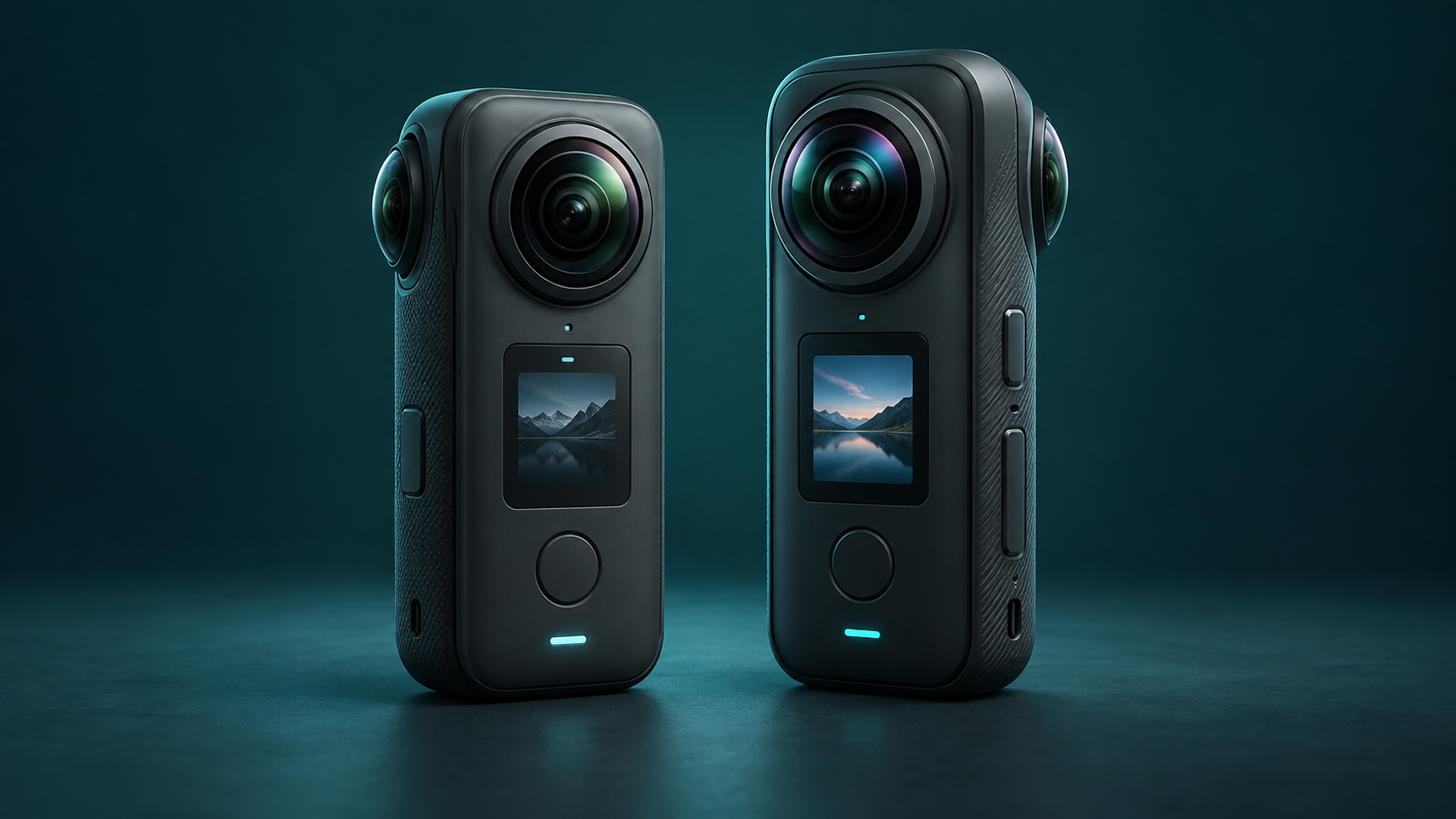
The useful differences at a glance
| Buying question | Insta360 X5 | Insta360 X6 | Practical effect |
|---|---|---|---|
| Physical sensor | Dual 1/1.28-inch sensors | Dual 1/1.1-inch sensors | Larger sensors on the X6 could help in difficult light; image quality still needs real footage to judge. |
| Highest listed 360 video | 8K at 30 fps | 8K at 50 fps | More frames at 8K for faster movement and smoother reframing. |
| 8K30 battery rating | About 93 minutes | About 140 minutes | A meaningful published advantage, but the maker’s test settings differ, so treat it as indicative. |
| Built-in memory | No built-in recording storage listed; microSD required | 64GB built in, about 47GB usable, plus microSD | The X6 can be useful when you forget a card, although large shoots still need extra storage. |
| Bare-camera waterproof rating | 15m / 49ft | 20m / 66ft | More headroom in water; a suitable dive case may still be needed for reliable 360 stitching underwater. |
| Screen | 2.5-inch LCD | 2.32-inch OLED | The X6 changes display technology but has a smaller diagonal. |
| Replaceable lenses | Yes | Yes, updated lens system | This is not a new reason by itself to replace an X5. |
| Approximate weight | 200 g | 196 g | Four grams lighter on paper; mounts and batteries change the carried kit. |
| Included battery | 2,400 mAh | 2,600 mAh | A larger cell accompanies the published runtime, without guaranteeing it in every mode. |
| Screen resolution | 440 × 696 pixels | 480 × 600 pixels | Different aspect ratios make diagonal size alone misleading. |
| Lens aperture | ƒ/2.0 | ƒ/2.0 | The nominal aperture does not change. |
| Mounting | 1/4-inch thread and quick release | 1/4-inch thread and quick release | Existing mounts may still help; check each accessory. |
| Dust rating | IP6X | IP6X | Same stated dust rating; still protect and clean the lenses. |
These are manufacturer specifications from the X6, X5 and official X Series comparison. We have not independently tested recording time, image quality or lens durability.
What does the X6 actually change for a person filming?
For someone who shoots cycling, skiing or other fast action in 360°, the move from 8K30 to 8K50 is the clearest recording upgrade. More frames give extra room for smooth motion at that resolution. The larger sensors may help in low light, but the two product pages are marketing and specifications, not a controlled side-by-side camera test. Do not assume every exported flat clip will look dramatically better just because the 360 source is 8K: reframing uses only part of the spherical image.
Insta360 describes the X6 as offering “1-inch 360 imaging.” Its own footnote says the physical sensors are 1/1.1-inch and produce an equivalent imaging area to a 1-inch sensor when shooting 360° in a 4:3 aspect ratio. If sensor dimensions are a deciding factor, compare the stated physical sizes rather than treating the slogan as the dimensions of each chip. The X5 uses dual 1/1.28-inch sensors.
The X6 also adds internal storage and a higher waterproof rating. These are practical conveniences: internal memory can rescue a short session without a microSD card; the depth rating gives more flexibility near water. Neither rating means that a bare 360 camera will stitch an underwater scene perfectly. Insta360 itself recommends a dedicated dive case for underwater 360 video.
Would I upgrade from an X5?
I would not replace a working X5 to obtain ordinary daylight travel clips or social videos. The X5 already records 8K30 360 video, has replaceable lenses, good stabilization features and can produce reframed footage. The X6 has meaningful improvements, but the question is whether your shoots are limited by the X5 today.
I would reconsider if I repeatedly run out of battery during 8K recording, need higher frame rates in 360°, or shoot in conditions where the larger physical sensors are useful. The X6’s approximately 140-minute 8K30 rating versus the X5’s approximately 93-minute rating is promising, yet the official comparison lists different test setups. It does not establish a measured 47-minute advantage in the same field conditions. A spare X5 battery may also be cheaper than a full upgrade.
If buying new, what price gap is worth paying?
The only reliable comparison is two offers in your country for equivalent standard kits. For context, Insta360’s Spain store showed an X6 standard bundle at €699 and an X5 standard bundle at €589.99 when we checked on 28 September 2026. That €109.01 difference is a dated Spanish store snapshot, not a US price or a guaranteed current offer. Promotions and kits can change even within the manufacturer’s store.
If your local gap is small, the X6 is a sensible new purchase for its 8K50 option, larger sensors, longer published endurance and internal storage. If the X5 is substantially discounted, I would spend the difference on a good microSD card, a spare battery and the mount I actually need. Compare return terms and what is included: the cheapest listed bundle is not always the cheapest ready-to-film setup.
Short answer
X5 owner: keep it unless a specific limitation is costing you shots. First-time 360 buyer: choose X6 when the extra cost is reasonable for your filming pattern; choose a discounted X5 for casual daylight use. The verdict is documentary purchasing analysis, not a hands-on review.